
How to Choose the Best Social Media Platforms for Your Business
Having a social media presence is essential for modern businesses. Our guide will help you choose the right social media platforms for your business.

Establishing your business on social media means building an identity that stands out and accurately represents who you are. It enables you to grow a community with your customers and start reaching more people. But with so many different options, choosing the right social media platforms to use for your business can feel overwhelming.
We’ve brought together some tips on how to decide on the best social media platforms for you and your business.
Why Choosing the Right Social Media Platforms Matters
Let’s get one thing straight: your business doesn’t have to be everywhere.
That’s one of the biggest mistakes we see businesses make with social media. Someone says, “You need to be on every platform!” and before you know it you’re trying to share content on seven different accounts, wondering why it’s not working.
Social media algorithms prefer content that is valuable and unique. When you spread yourself too thin, repeat posts, or copy what your competitors are doing then you’re not going to see good results from your social media marketing.
It’s not about posting everywhere: it’s about posting with purpose. Strong, unique and consistent posts on three social media platforms will always outperform seven neglected platforms. You’ll see better reach, stronger engagement and more meaningful community growth when you focus on doing fewer things really well.
Start With Your Social Media Goals
Ask yourself what your business goals are for your social media platforms. Why are you there? What do you ultimately want to get out of using social media for your business?
Social media platform goals can include:
- Brand awareness
- Reputation management
- Lead generation
- Sales, enquiries & conversions
- Customer support & community building
- Thought leadership
It’s fine to have multiple goals or for them to change and grow over time. You might end up tying different goals to different platforms, such as using TikTok for brand awareness, Facebook for customer support and LinkedIn for thought leadership.
Identifying these goals will help you choose social media platforms based on their outcomes, rather than chasing vanity metrics.
Understand Where Your Target Audience Is – And Who They Are
The truth? You only need to show up where your audience actually is and where your content makes sense. Think about the characteristics of your audience before you choose a platform to focus on.
Think about whether your business is selling to other businesses (B2B – business to business) or directly to the end customer (B2C – business to consumer). Audience characteristics like age, location and interests can then be used to make a final decision on which social media platform to use.
Take some time to think about who your ideal customer is and who is already a part of your audience. If your audience is full of professionals who love a good leadership quote and a bit of business chat, LinkedIn is the place to be. If they’re into home inspo, DIY, recipes or aesthetics, Instagram and Pinterest are perfect. And if your audience loves real, authentic, personality-driven content, TikTok is probably your best bet.
The Easiest Way To Find Your Audience
Check your website analytics and look at where your existing followers hang out.
Connecting your website to tools like Google Search Console, Bing Webmaster, or Google Analytics 4 can give you valuable insights into how people are finding and using your website. Information that can that help you choose the right social media platforms for your business can include:
- Acquisition
- This shows how people are finding your website. You will be able to see how many people are already visiting through social media and which specific platforms they’re using.
- User attributes
- This will show you demographic data about your audience. You’ll be able to see what country they’re in, gender, age, and some of their interests.
- Search queries
- This section will list the search terms that people have used to find your website. Looking into this data can give you ideas of what kind of social media content will be helpful for your audience.
Using data in this way will give you a well-rounded view of who your audience are, as well as how it’s best to connect and engage with them.
Matching Major Social Media Platforms To Your Goals
Every platform has its own ‘thing’. Choosing the right social media platform for your business depends on your goals, what you naturally create and how people prefer to connect with you.
Social media platforms do change their features regularly, so it’s important to keep on top of updates.
Here’s an overview of some of the most popular platforms.
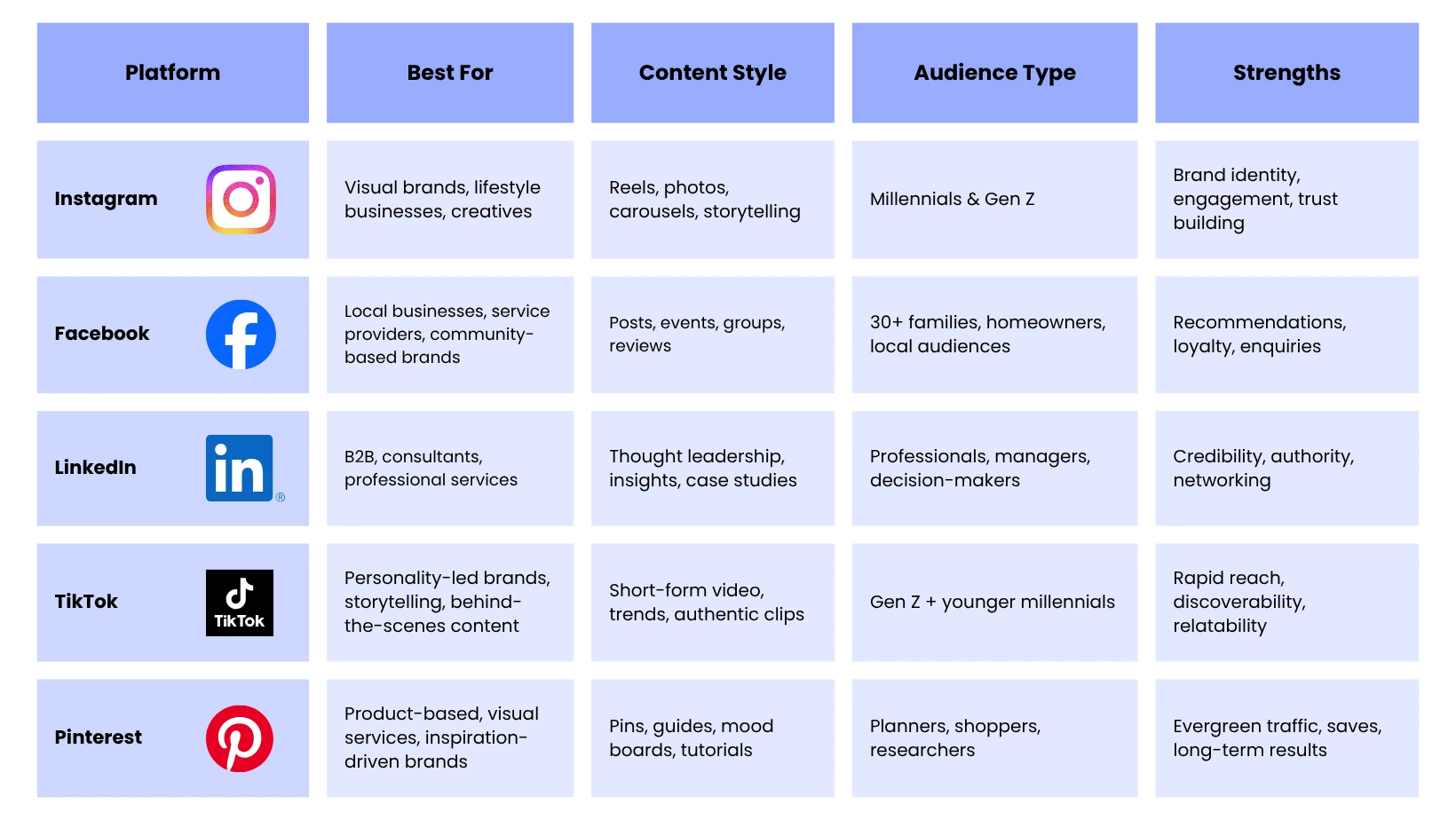
Choosing Platforms Based On Your Strengths
You don’t need to make things more difficult for yourself. By taking the time to think about what you currently do well as a business, you can make the process of choosing a platform and creating content so much easier.
Do you manufacture products on site? Behind the scenes production details can do well on platforms like LinkedIn.
Do you have some big office personalities? You could encourage them to jump on fun new TikTok trends.
Do you have an aesthetically pleasing business or products? Instagram and Pinterest are both extremely visual platforms.
If you’re struggling to decide where your strengths are and what platforms are the best choice for your business, ask yourself:
- What would a layperson find most interesting about my business?
- What platform am I/my team able to commit to for a few months?
Start Small, Then Scale
In the long term, you might want your business to be active on multiple social media platforms. But when you’re starting from scratch you need to master one or two platforms first. Build a routine, get consistent, learn what works.
Once you’ve got the data to back up what does and doesn’t work, you can refine your content. Improving it based on results will enable you to have more impact for less effort.
When you’ve got the capacity to expand, you’ll be able to start posting consistently on additional social media platforms. Your previous work will give you confidence of knowing what works for your audience. You can then tweak and adapt your content to suit different platforms.
Common Mistakes To Avoid
Jumping on every new platform
There’s always a new platform making waves and it’s tempting to jump straight on the bandwagon. But before you do, take a step back and ask:
- Is my audience actually there?
- Does this help my business goals?
- Do I have time (or help) to keep it consistent?
If you can’t say yes to all three, it’s probably not the right move yet.
Posting the same content on every platform
Each platform prefers different types of content. What works on TikTok will probably not be as successful on LinkedIn. When you post the same content across every platform it tells the social media algorithms (and your audience) that you haven’t put in the time to create specific content for different people.
Even at a functional level, the way that each platform handles content is different. Character limits can vary, video and photo dimensions can be different. Functions like hashtags, links, or tagging may not be the same across all platforms.
Ignoring analytics
Every platform will have a section that shows you analytics. This can be extremely helpful information, so take advantage of this data! Analytics can show you what content your audience is engaging with, plus vital information about who your audience are. You can then adjust your content creation plans to target your audience more specifically.
Tracking analytics can also show how you’re changing (and improving). Creating a solid audience of engaged viewers takes time. By tracking your growth you can assess what is (and isn’t) working without feeling discouraged.
Copying your competitors
Taking inspiration from other businesses in your sector isn’t a bad thing, but copying their social media content too closely can negatively affect your own performance. Your competitor’s business may be similar but not the same as your business. That’s why you’re competitors! They will have different processes, a different audience, and different resources.
Social media rewards unique content that is valuable for your audience. By copying other businesses you’re creating content for their audience instead of yours.
Trying to go viral
This might seem counter-productive! We’re not suggesting that you avoid going viral, just that you don’t chase after it. By only focussing on trending topics or popular platforms, you’re ignoring what is actually valuable for your audience.
If (when) you go viral for something, it’s more beneficial for a new audience to see a backlist of authentic and helpful content that shows your business in the best light.
Next Steps
- Define your goals
- Identify your target audience
- Choose 1-2 platforms
Assess your time and resources
You should consider the resources you have available to commit to a social media platform. Content creation can be a very involved process. If you have a dedicated marketing team you’ll have more resources to spare than if you’re a solo business owner.
Checking you have the capacity for different platforms and content can help you create a realistic social media marketing plan. By continuously assessing, you can allocate your resources to the platforms and types of content that have the most impact.
If you have a limited amount of time to spend on social media content then there are still some good social media platform options. Content on Pinterest is evergreen, meaning that it will be shown to new audiences for a long period of time. Many popular TikTok videos are short, off the cuff clips that can be filmed and uploaded quickly. Longer thought-pieces or case studies on LinkedIn can be more time consuming to create, but offer significant credibility and authority.
Consider social media management support
A marketing agency can offer expert social media support, which can be especially useful if you’re short on time or unsure where to start. They can craft a bespoke content strategy as well as identifying which social media platforms make sense for your goals and your audience. They’ll support you so your business shows up in a way that feels natural, consistent and true to your brand.
Agency support for social media can also be beneficial long-term if you have limited time or resources. They have the experience to know what works and stay on top of the latest algorithm changes. This can free up time to focus on the rest of your business.
Decide on a test period and success metrics
Creating an initial social media plan for 30-90 days gives you some time to experiment. A short testing period with clear success metrics will help you to analyse what is and isn’t working. You should use consistent metrics to analyse your content’s performance so the results are comparable.
You don’t need to be everywhere or do everything. You just need to show up on the right social media platforms with a clear sense of purpose. When you focus your time and energy where it actually counts, your business’s social media presence can be a lot more effective. With the right approach, you’ll soon be having a meaningful impact.
Are you looking for a marketing agency to partner with?
You might also like
Drew joined us for a six-month T Level placement as a junior digital marketer. We gave him a flavour of our agency’s work across ads, SEO, social media and websites.

The risks of losing track of log-ins and passwords Secure digital access management is crucial for businesses of all sizes. Imagine a staff member leaves suddenly and you realise that no one else in the Read more...

You’ve probably noticed how hard it is to get people to fill in forms or pick up the phone these days. Everyone wants instant replies, or to share pictures and drawings quickly.